ABF Crystal: A Leap Forward in VUV Nonlinear Optical Materials
Editor: | Dec 09,2025
Vacuum ultraviolet (VUV, 100–200 nm) light sources are indispensable for advanced spectroscopy, quantum research, and semiconductor lithography. Second harmonic generation (SHG) using nonlinear optical (NLO) crystals is one of the simplest and most efficient ways to generate VUV light, but the scarcity of suitable NLO crystals has long been a bottleneck. A research team led by Prof. Shilie Pan from the Xinjiang Technical Institute of Physics and Chemistry, Chinese Academy of Sciences, has successfully developed the fluorooxoborate crystal NH4B4O6F (abbreviated as ABF), a transformative solution to practical VUV NLO material challenges. This work was published in Nature.
The research team has overcome key challenges in crystal growth and developed an optimized vapor deposition method to produce high quality centimeter scale ABF single crystals.
ABF stands out with practical performance that meets real world needs. It can transmit light across a wide range from VUV to near infrared, with its ability to let VUV light pass starting at a short wavelength of 155.0 nm. This means it works well for important VUV wavelengths like 177.3 nm and 193 nm, which are used in high precision analysis and semiconductor manufacturing.
As a special type of optical crystal, ABF achieves a remarkable feat by generating VUV light as short as 158.9 nm through SHG. This shorter wavelength opens new doors for scientists to explore deeper into fields like superconductivity and chemical reactions.
Constructing VUV devices with specific phase matching angles is a significant technical challenge. It relies heavily on the availability of high-quality large-size single crystals, as well as exceptional precision in fabrication and alignment. In practical applications, ABF delivers impressive performance. Its strong wavelength conversion capability enables the production of high-energy VUV light, achieving a maximum nanosecond pulse energy of 4.8 mJ at 177.3 nm with a conversion efficiency of 5.9%. These values represent the highest nanosecond pulse energy and conversion efficiency ever reported for VUV SHG devices.
The secret behind ABF’s excellent performance lies in a smart design strategy. By introducing fluorine into borate system, researchers created unique atomic groups that make the crystal more effective at converting light. This design also helps the crystal form an ordered structure, further boosting its optical capabilities without sacrificing other important properties.
The development of ABF paves the way for compact and efficient all solid state VUV lasers. This advancement will make VUV light more accessible for use in science and industry, driving progress in areas like advanced chip manufacturing and cutting edge scientific research.
This research was supported by the Strategic Priority Research Program of the Chinese Academy of Sciences (XDB0880000), the Tianshan Innovation Team Foundation (2022TSYCTD0005), the CAS Youth Interdisciplinary Team Foundation (JCTD-2022-19), the National Natural Science Foundation of China (22335007, 22193044), and the Xinjiang Major Science and Technology Project (2021A01001).
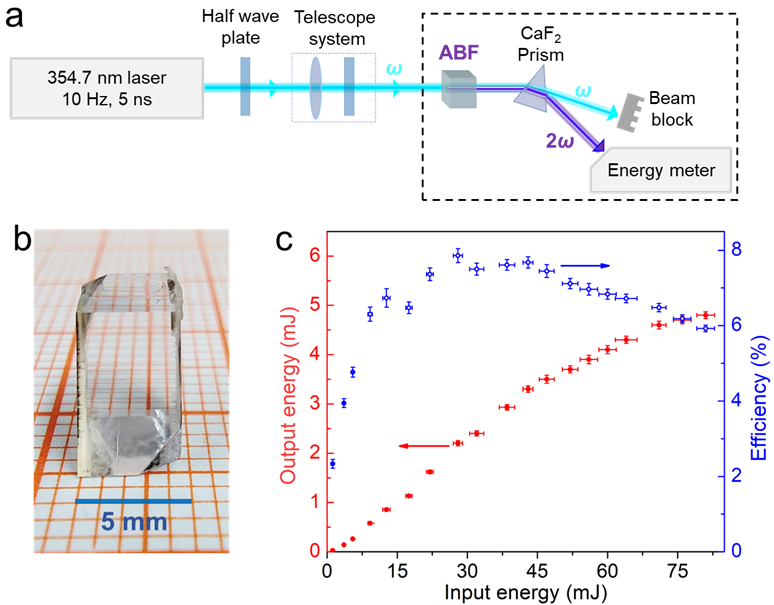
Figure: High-efficiency frequency doubling output of ABF. (a) Schematic of the setup for 177.3 nm high-energy VUV nanosecond laser generation in ABF. (b) Device fabricated with phase-matching angle for SHG at 354.7→177.3 nm. (c) Output energy and conversion efficiency for SHG at 354.7→177.3 nm. (Images provided by Shilie Pan’s group.)
附件下载:
 86-991-3835823
 lhszhb@ms.xjb.ac.cn
 86-991-3838957
 40-1 Beijing Nan Road, Urumqi, Xinjiang, 830011, China


Copyright @ Xinjiang Techinical Institute of Physics and Chemistry, Chinese Academy of Sciences. All Rights Reserved
