Progress in Fluorooxoborate Deep-Ultraviolet Nonlinear Optical Crystals
Editor: | Jan 21,2026
Deep-ultraviolet (DUV, λ < 200 nm) all-solid-state lasers, as indispensable tools in modern scientific research and industrial manufacturing, are widely utilized in fields such as material analysis and lithography. Their commercialization relies heavily on high-performance nonlinear optical (NLO) crystals. However, the development of such crystals is constrained by stringent application requirements, as they must simultaneously possess balanced optical properties, including large Second Harmonic Generation (SHG) responses, moderate birefringence, and wide bandgaps. For a long time, borates have been a focal point of intensive research due to their excellent DUV transmission properties. Although materials such β-BBO and LBO have been developed, most fail to achieve DUV phase matching via direct frequency doubling. Fluoroborate systems have emerged as prominent candidates owing to their structural diversity and superior performance. However, existing materials like KBBF suffer from drawbacks such as layered growth habits and the toxicity of raw materials. Furthermore, DUV NLO crystals containing chain-like polymerized [BO3]3- units are remarkably scarce. Consequently, achieving the ordered arrangement of functional units through structural design has become a pivotal issue for breaking through the performance bottlenecks of DUV NLO materials.
The Research Center for Crystal Materials at the Xinjiang Technical Institute of Physics and Chemistry (XTIPC) proposed a structural design strategy based on the synergistic assembly of fluorinated polyhedra and planar B–O groups. By leveraging the "shearing" effect and directional polymerization capability of fluorinated polyhedra, they achieved the uniform alignment of π-conjugated functional units, leading to the successful synthesis of a series of alkali metal fluoroborates: KABF, RABF, and CABF. The innovation of this work lies in the use of fluorinated polyhedra to regulate the orientation of planar B–O units, constructing novel structures containing 1∞[BO2] chains. In these structures, the [BO3F]4- tetrahedra and chain-like polymerized [BO3]3- units undergo synergistic assembly to form parallel-aligned 2∞[B4O6F] layered structures. The materials exhibit exceptional performance: the SHG responses reach 1.6–1.7 × KDP (1064 nm) and 0.4–0.5 × BBO (532 nm), with the shortest Type I phase-matching wavelengths as low as 161.5–168.6 nm and UV cutoff edges below 190 nm. This strategy overcomes the challenges of controlling the construction of chain-like polymerized [BO3]3- units and the assembly of non-centrosymmetric structures. Through cation-mediated structural adaptation, it demonstrates the stability and diversity of the fluoroborate system. This work not only provides high-performance candidates for DUV NLO crystals but also establishes a design paradigm for the synergistic interaction between fluorinated polyhedra and polymerized [BO3]3- units. It paves a new way for the development of beryllium-free, low-toxicity DUV NLO materials, driving laser technology toward higher precision and broader applications.
The research paper, titled "Constructing Deep-Ultraviolet Nonlinear Optical Crystals via Synergistic Combination of Fluorinated Polyhedra and Polymerized BO3 Units," has been published inAdvanced Functional Materials, a prestigious journal in the field of materials science. PhD student Hongkang Su is the first author, with Professors Min Zhang and Shilie Pan serving as the corresponding authors. This research was supported by the National Key Research and Development Program of China, the the National Natural Science Foundation of China, and various projects of the Xinjiang Uygur Autonomous Region. Figure 1. (a) Representative structures of the synergistic combination of fluorinated polyhedra and π-conjugated B–O groups; (b) DUV NLO crystals designed and synthesized in this work.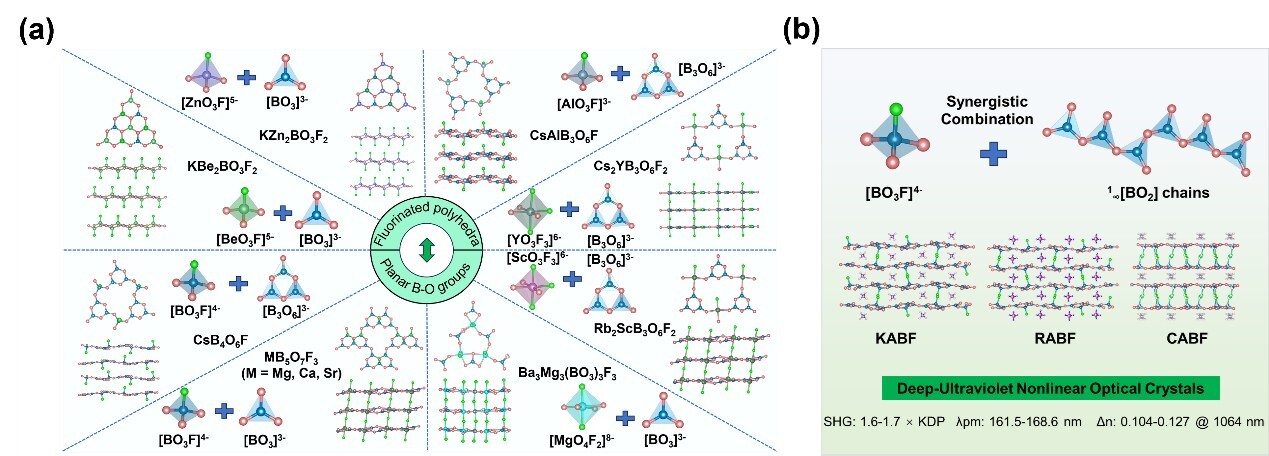
附件下载:
 86-991-3835823
 lhszhb@ms.xjb.ac.cn
 86-991-3838957
 40-1 Beijing Nan Road, Urumqi, Xinjiang, 830011, China


Copyright @ Xinjiang Techinical Institute of Physics and Chemistry, Chinese Academy of Sciences. All Rights Reserved
