Research Progress in Borate UV Birefringent Crystals
Editor: | Jan 21,2026
Recently, the Research Center for Crystal Materials of the Xinjiang Technical Institute of Physics and Chemistry, Chinese Academy of Sciences, has achieved new progress in the research on borate ultraviolet (UV) birefringent crystals. The research team innovatively proposed a strategy of using complementary hydrogen bonds to optimize the alignment of π‑conjugated units and successfully designed and synthesized a new hydroxy‑fluorinated borate nitrate crystal Cs2[B3O3F2(OH)2](NO3)·[B3O3(OH)3] which exhibits the largest birefringence among alkali/alkaline‑earth metal fluoroborates This work provides a new idea for developing novel borate UV optical crystals.
Birefringence is an important optical property in which crystal materials show anisotropic refractive indices to polarized light thus playing a key role in modern photoelectric technologies such as integrated optical modulators electro‑optic switches and nonlinear optical frequency conversion. However, birefringence usually relies on the polarizability anisotropy of anionic functional units and their arrangement. Therefore, screening anionic units with large polarizability anisotropy and aligning them in a consistent direction is the core idea for designing birefringent crystals. Borates have become a preferred system for designing UV/deep‑UV optical crystals due to their rich structural chemistry and excellent optical performance.
The research team proposed a strategy of using complementary hydrogen bonding between π‑conjugated units to achieve local parallel alignment. By assembling isolated planar units with multiple hydroxyl groups [B3O3(OH)3] and [B3O3F2(OH)2], they successfully designed and obtained Cs2[B3O3F2(OH)2](NO3)·[B3O3(OH)3]. Its anionic framework is constructed through hydrogen‑bond‑directed assembly of three different isolated π‑conjugated building blocks [B3O3(OH)3], [B3O3F2(OH)2] and [NO3]. Complementary hydrogen‑bond interactions overcome the inherent difficulty of aligning these different π‑conjugated units enabling their complete parallel alignment. This consistent coplanar arrangement produces a record‑high birefringence (Δn = 0.149@546 nm) among alkali/alkaline‑earth metal borates surpassing commercial α‑BaB2O4 while achieving a large band gap of 5.82 eV which is very suitable for UV applications. First‑principles calculations confirm that the planar π‑conjugated groups dominate the large optical anisotropy and the hydrogen‑bond network is crucial for the coplanar alignment. Cs2[B3O3F2(OH)2](NO3)·[B3O3(OH)3] establishes a new paradigm for engineering high‑performance birefringent crystals by directionally assembling diverse π‑conjugated units through complementary hydrogen‑bond interactions.
This research has been published in Small (Small2025, DOI:10.1002/smll.202511399), with Researcher Shilie Pan, Researcher Shujuan Han and Researcher Miriding Mutailipu of the Research Center for Crystal Materials as the corresponding authors, and the Doctoral student Ruyi niu as the first author. This work was supported by the Tianshan Innovation Team Program, the National Key R&D Program of China, the National Natural Science Foundation of China, the Xinjiang Tianshan Talents Program, the CAS International Partnership Program “Future Partner Network Project”, the Natural Science Foundation of Xinjiang and the Xinjiang Major Science and Technology Project. The Strategic Priority Research Program of the Chinese Academy of Sciences, and the Xinjiang Major Science and Technology Project.
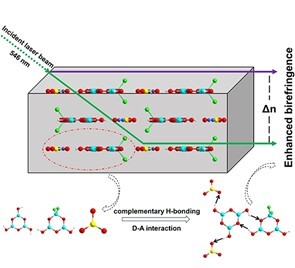
TOC: Complementary hydrogen bond-Regulated π-conjugated Layered Structures Achieve Substantial Enhancement of Birefringence
附件下载:
 86-991-3835823
 lhszhb@ms.xjb.ac.cn
 86-991-3838957
 40-1 Beijing Nan Road, Urumqi, Xinjiang, 830011, China


Copyright @ Xinjiang Techinical Institute of Physics and Chemistry, Chinese Academy of Sciences. All Rights Reserved
