Progress in Mid- and Far-Infrared Birefringent Crystals
Editor: | Jan 22,2026
Mid- and far-infrared birefringent crystals are key functional materials for polarization control, laser technologies, and infrared photonics. However, existing materials generally suffer from limited infrared transparency, the intrinsic trade-off between large birefringence and wide transmission windows, and difficulties in optical characterization arising from restricted crystal dimensions. Owing to their heavy-element composition and unique coordination environments, Hg-based chalcogenides have been considered promising candidates for achieving the coexistence of strong birefringence and broad infrared transparency. Nevertheless, systematic understanding of their structural design principles and structure-property relationships remains lacking. Recently, researchers constructed a novel Hg-based chalcogenide, Hg18Ga8Se8Cl32, featuring linear [Hg3Se2] building units, and systematically investigated its crystal structure, optical properties, and thermal response behavior. By combining experimental characterizations with theoretical calculations, the structural origin underlying the synergistic realization of giant birefringence and ultrabroad infrared transparency was elucidated. In addition, an infrared birefringence measurement strategy suitable for small-sized crystals was proposed, providing new insights for the design and characterization of emerging mid- and far-infrared birefringent materials.
The Research Center for Crystal Materials of the Xinjiang Technical Institute of Physics and Chemistry, Chinese Academy of Sciences, has for the first time constructed linear multinuclear [Hg3Se2] cluster building units in Hg-based chalcogenide systems. These linear clusters are highly ordered along a specific crystallographic direction, forming a pseudo-tridymite-like topological framework. Distinct from conventional tetrahedral or chain-like chalcogenide structures, the linear Hg clusters exhibit pronounced orientational consistency within the crystal lattice, offering a new structural design paradigm for realizing strong optical anisotropy.
The obtained Hg18Ga8Se8Cl32 single crystals simultaneously exhibit an ultrabroad infrared transparent window spanning 0.4-25 μm, covering key mid- and far-infrared atmospheric windows, and a giant birefringence of up to 0.871 at 546.1 nm. Notably, a high birefringence value of 0.453 is still maintained at 3.5 μm. This combination of optical properties ranks among the best performances reported for Hg-based chalcogenides and infrared birefringent crystals, effectively overcoming the long-standing limitation that large birefringence and wide infrared transparency are difficult to achieve concurrently.
Considering that newly developed infrared crystals are often only available in millimeter-scale sizes, rendering conventional mid-infrared birefringence measurement techniques impractical, this work proposes and validates an infrared birefringence measurement method based on polarization-state modulation and phase-retardation analysis. By precisely analyzing the phase difference between two orthogonal polarization components, this approach enables quantitative determination of birefringence in small-sized crystals from the near-infrared to the mid-infrared spectral regions.
By integrating variable-temperature single-crystal X-ray diffraction, in situ Raman spectroscopy, and first-principles calculations, the microscopic origin of the outstanding optical properties of Hg18Ga8Se8Cl32 was systematically revealed. Both experimental observations and theoretical analyses consistently demonstrate that the linear [Hg3Se2] units possess the highest polarizability anisotropy (δ ≈ 430) among all known birefringence-active structural units. Their highly oriented arrangement within the crystal lattice significantly amplifies the overall birefringence. Meanwhile, a dynamic lattice distortion mechanism dominated by electron-phonon coupling accounts for the reversible thermochromic behavior of the material.
The related research paper, entitled “[Hg3Se2]2-cluster drives giant optical anisotropy and broad infrared transparency,” was published in the authoritative materials science journal Nature Communications. Xinjiang Technical Institute of Physics and Chemistry, Chinese Academy of Sciences, is the sole completing institution. Doctoral student Ren Qixian and Associate Researchers Cui Chen and Chen Xinchen are the first authors, while Associate Researcher Wu Yabo and Researcher Pan Shilie serve as the corresponding authors. This work was supported by the National Key Research and Development Program of China, the Shanghai Cooperation Organization Science and Technology Partnership Program, the National Postdoctoral Program for Innovative Talents, and the “Tianchi Talents” Program of Xinjiang Autonomous Region.
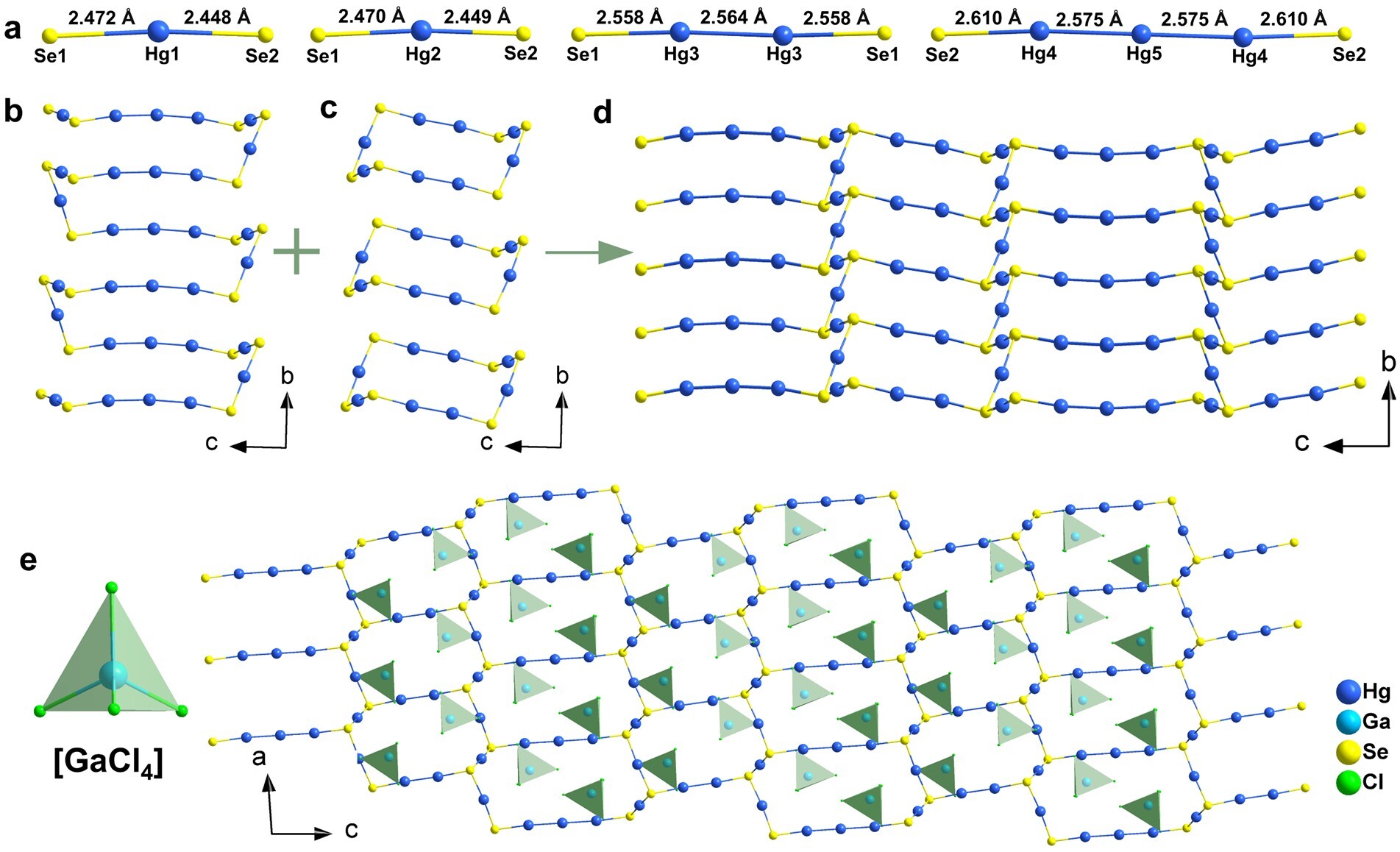
Fig 1. a Coordination environment of Hg atoms inHg18Ga8Se8Cl32. b A one-dimensional helical channel along the b-axis. c A chair-like conformation of Hg8Se6 along the b-axis. d Alternating antiparallel stacking of helical channels and chair-like conformations along thec-axis. e Crystal structure of Hg18Ga8Se8Cl32 viewed along the b-axis.
附件下载:
 86-991-3835823
 lhszhb@ms.xjb.ac.cn
 86-991-3838957
 40-1 Beijing Nan Road, Urumqi, Xinjiang, 830011, China


Copyright @ Xinjiang Techinical Institute of Physics and Chemistry, Chinese Academy of Sciences. All Rights Reserved
