Progress in Machine Learning-Assisted Performance Prediction of Pervaporation Membrane
Editor: | Mar 09,2026
The efficient dehydration of alcohols such as ethanol represents a significant demand in bioenergy, chemical, and pharmaceutical industries. Pervaporation, recognized as a highly efficient, energy-saving, and readily scalable membrane separation technology, is considered one of the most promising alternative solutions. However, the development of high-performance membranes has long relied on expensive and time-consuming "trial-and-error" approaches. Given that membrane performance is influenced by complex interactions among multiple factors—including polymer structure, operating conditions, and solvent properties—establishing accurate predictive models has remained a critical challenge in this field.
Recently, the Separation Materials and Technology Team at the Xinjiang Technical Institute of Physics and Chemistry, Chinese Academy of Sciences, successfully achieved precise prediction of pervaporation membrane performance for alcohol-water mixtures using machine learning algorithms, providing novel theoretical support for accelerating the design of high-efficiency separation membranes. The research team constructed a pervaporation membrane performance database containing 1,081 samples by collecting experimental data from published literature over the past two decades, encompassing multi-dimensional features such as membrane structural parameters, operating conditions, and solvent properties. By comparing various machine learning models, the gradient boosting decision tree-based CatBoost model demonstrated optimal stability and accuracy in flux prediction, while the Extreme Gradient Boosting (XGBoost) model exhibited the strongest explanatory power and generalization capability in separation factor prediction—validating the significant advantages of ensemble learning algorithms in modeling complex chemical engineering data (Figure 1).
Mechanistic analysis revealed that the Hildebrand solubility parameter of polymers is the most critical physicochemical factor influencing membrane separation performance. This parameter directly determines the interaction intensity between membrane materials and solvent molecules. Through SHAP (SHapley Additive exPlanations) interpretability analysis—a model explanation method based on Shapley values from game theory—the study quantitatively revealed the contribution of each feature to membrane performance from a data perspective, further confirming the core role of the solubility parameter in regulating selectivity and flux. Additionally, the team employed two-dimensional partial dependence plots to visualize key parameter combinations (such as "polymer concentration–crosslinker concentration" and "temperature–solubility parameter"), clearly presenting synergistic or antagonistic effects under different preparation and operating conditions, thereby providing an intuitive "performance map" for precise membrane design and process optimization.
Furthermore, to fully validate the model's robustness and generalizability, the team first conducted completely independent blind tests within the ethanol-water system; subsequently, the model was extended to isopropanol-water and n-butanol-water separation systems with distinct molecular structures and polarities, maintaining high accuracy with R² > 0.94 in flux prediction. Ultimately, based on the optimal parameter combinations identified by the model, the team successfully guided the fabrication of a polyvinyl alcohol/basalt fiber composite membrane. This membrane achieved outstanding performance in the dehydration of 95 wt% ethanol, with a permeation flux of 113.5 g·m⁻²·h⁻¹, separation factor of 90.6, and comprehensive separation index of 10169.6—multiple indicators surpassing those of similar membrane materials reported in the literature—completing a closed-loop validation from "predicting performance" to "creating performance."
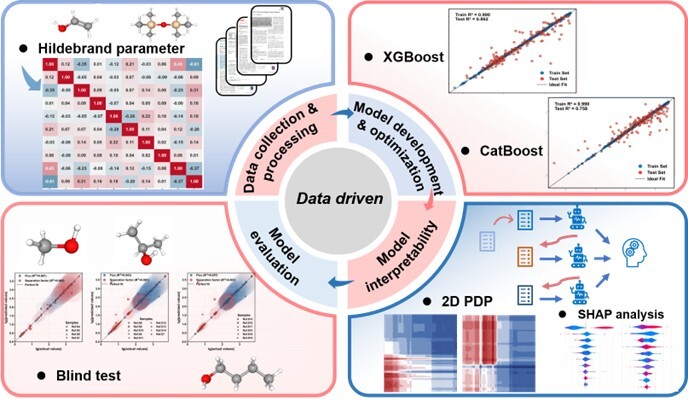
Figure 1. Workflow of machine learning-assisted prediction of pervaporation separation performance for alcohol-water mixtures
This research not only provides a reliable tool for intelligent design and performance prediction of pervaporation membranes but also offers methodological references for machine learning modeling of other membrane separation systems, holding significant theoretical value and application prospects. The related research results were published in Separation and Purification Technology.
附件下载:
 86-991-3835823
 lhszhb@ms.xjb.ac.cn
 86-991-3838957
 40-1 Beijing Nan Road, Urumqi, Xinjiang, 830011, China


Copyright @ Xinjiang Techinical Institute of Physics and Chemistry, Chinese Academy of Sciences. All Rights Reserved
