Progress in Photothermal-Electrothermal Integrated Interfacial Evaporation System for Brackish Water Purification
Editor: | Mar 14,2026
Freshwater shortage, driven by global population growth, industrialization, and climate change, demands the development of effective water purification technologies. Brackish water and seawater desalination is a promising solution, yet conventional desalination techniques are hampered by their high costs, complexity, and energy intensity. Solar interfacial evaporation (SIE) has exhibited high efficiency and environmental benefits, but its practical application is hindered by diurnal intermittency, weather instability, and salt fouling.
To address these challenges, Prof. Abudukeremu Kadier and Prof. Peng-Cheng Ma’s group at the Xinjiang Technical Institute of Physics and Chemistry (XTIPC) of the Chinese Academy of Sciences (CAS) have successfully developed a three-dimensional photothermal-electrothermal synergistic interfacial evaporation system (P-ECIES) based on invasive plant wood and basalt fiber fabric, providing an innovative solution for stable freshwater acquisition in all-weather and high-salinity conditions. The system innovatively integrates solar interfacial evaporation with low-voltage Joule heating, creating a “light-electrical-heat” tripartite synergistic driving mechanism that overcomes the dependence of traditional SIE on light conditions. The core of the system consists of two parts: the upper layer is a Ti2O3/PDA@wood photothermal evaporator prepared from wood blocks of the invasive plant Rhus typhina L., which has excellent photothermal conversion and water transport capabilities; the lower layer is an electrothermal layer made of Ag/PPy-modified basalt fiber fabric (Ag/PPy-BF), which has good electrical conductivity and thermal stability and can continuously generate heat at low voltages.
Under the synergistic action of 1 sun irradiation and 1.5 V voltage, an evaporation rate of 7.46 kg·m-2·h-1 was achieved. Even in a high-salinity solution of 10.5 wt%, a stable evaporation performance of 4.71 kg·m-2·h-1 was maintained. Moreover, the system achieved a salt ion removal rate of over 99.91% for major ions such as Na+, K+, Ca2+, and Mg2+, with the treated water quality meeting the drinking water standards set by the World Health Organization (WHO) and the National Health Commission (NHC) of China. In practical applications, the team conducted a 24-hour all-weather test using brackish water samples collected from Ebinur Lake in Xinjiang. During the test, the evaporation rate of the system remained stable at 4.31-4.68 kg·m-2·h-1 (1.5 V) and 1.75-1.93 kg·m-2·h-1 (1 sun irradiation), with only a small amount of salt crystallization on the surface, which did not significantly affect the performance, demonstrating excellent salt resistance and long-term stability. In addition, the system significantly improved water quality indicators such as organic matter (COD removal rate of 80.06%), suspended solids (SS removal rate of 100%), turbidity, and color, resulting in clear and transparent treated water with an electrical conductivity reduction of over 98%. This fully validated the system's efficiency and reliability in practical brackish water treatment. This study not only explores a new path for the resourceful utilization of invasive plants but also provides a new idea for building a green, low-carbon, and sustainable distributed freshwater acquisition system.
The results were recently published in the international journal Desalination. This research was supported by the Natural Science Foundation of Xinjiang Uygur Autonomous Region, the Shanghai Cooperation Organization Science and Technology Partnership Program, and the International Science and Technology Cooperation Program.
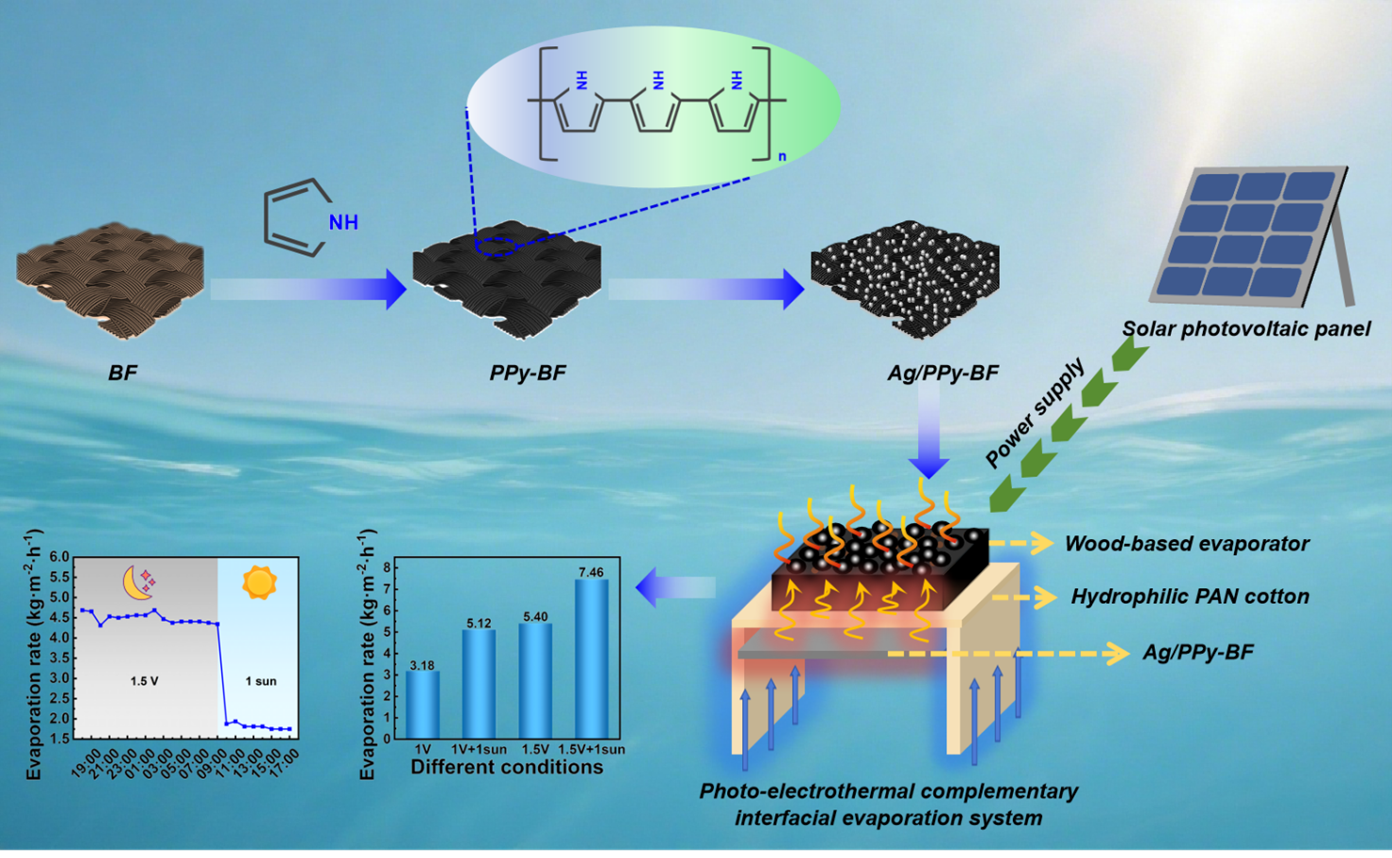
Figure 1. Fabrication and performance testing of the photothermal-electrothermal synergistic interfacial evaporation system.
附件下载:
 86-991-3835823
 lhszhb@ms.xjb.ac.cn
 86-991-3838957
 40-1 Beijing Nan Road, Urumqi, Xinjiang, 830011, China


Copyright @ Xinjiang Techinical Institute of Physics and Chemistry, Chinese Academy of Sciences. All Rights Reserved
