Researchers Develop Highly Stable Nickel-Based Catalyst for Efficient Hydrogen-Rich Syngas Production from Biomass Gasification
Editor: | Apr 26,2026
Biomass resources are abundant and renewable, which is a key way to realize resource utilization of agricultural wastes and low-carbon energy supply. Biomass gasification has drawn wide attention for its ability to produce hydrogen-rich syngas. However, it inevitably produces a large amount of condensable tar, which causes condensation corrosion, pipeline blockage, reduces gasification efficiency, and limits the continuous and stable operation of the whole system.
Adding catalysts to gasification systems is one of the most effective methods to remove tar. Ni-based catalysts are widely used to improve tar conversion and hydrogen yield because of their high activity in tar cracking, steam reforming and water-gas shift (WGS) reactions. But Ni-based catalysts usually deactivate quickly under biomass gasification conditions. On one hand, Ni nanoparticles tend to sinter under high-temperature steam and reducing atmospheres, reducing available active sites. On the other hand, tar and its aromatic intermediates easily condense at acidic sites, accelerating the formation of ordered encapsulated coke deposition. The deposited coke covers Ni active sites and blocks pore channels, making catalyst deactivation worse. Therefore, achieving high dispersion and structural stability of active Ni sites while inhibiting coke deposition is the key scientific issue to improve the long-term performance of Ni-based catalysts.
Research group from the Xinjiang Technical Institute of Physics and Chemistry (XTIPC), Chinese Academy of Sciences (CAS) have constructed a highly stable Ni@HAlBeta catalyst to solve the core bottleneck of nickel (Ni)-based catalysts' coupled deactivation by sintering and coke deposition. This work was published in Journal of the Energy Institute.
In this study, the research team proposed a synergistic strategy combining dealumination defect engineering and regulation of the nickel acetylacetonate (Ni(acac)2) precursor pathway. They first achieved controllable dealumination of beta zeolite to create defective sites rich in silanol nests and reduce strong acidity. Then they adopted a mechanical mixing, calcination and reduction route with Ni(acac)2 and dealuminated zeolite. During thermal treatment, Ni species diffused in gas phase to achieve high dispersion. The enhanced metal-support interaction via defect anchoring effectively inhibited metal sintering. Meanwhile, the reduced acidity suppressed aromatization and condensation reactions, as well as the generation of encapsulated coke precursors.
At 750 °C with a steam-to-carbon (S/C) ratio of 4, the Ni@HAlBeta catalyst achieved a hydrogen yield of 31.4 mmol/gbiomass and a tar conversion efficiency of 92.3%. After 15 consecutive cycles, the hydrogen yield still remained at 24.0 mmol/gbiomass. The Ni particle size was stabilized at about 5.8 nm, and the coke deposition content was only 27.9 mg/gcatalyst. The deposited coke was mainly low-ordered and non-encapsulated, which avoided the coverage of active sites and ensured excellent catalytic durability.
This work provides a novel structural design strategy for tar removal in biomass gasification and the long-term stable operation of Ni-based catalysts.
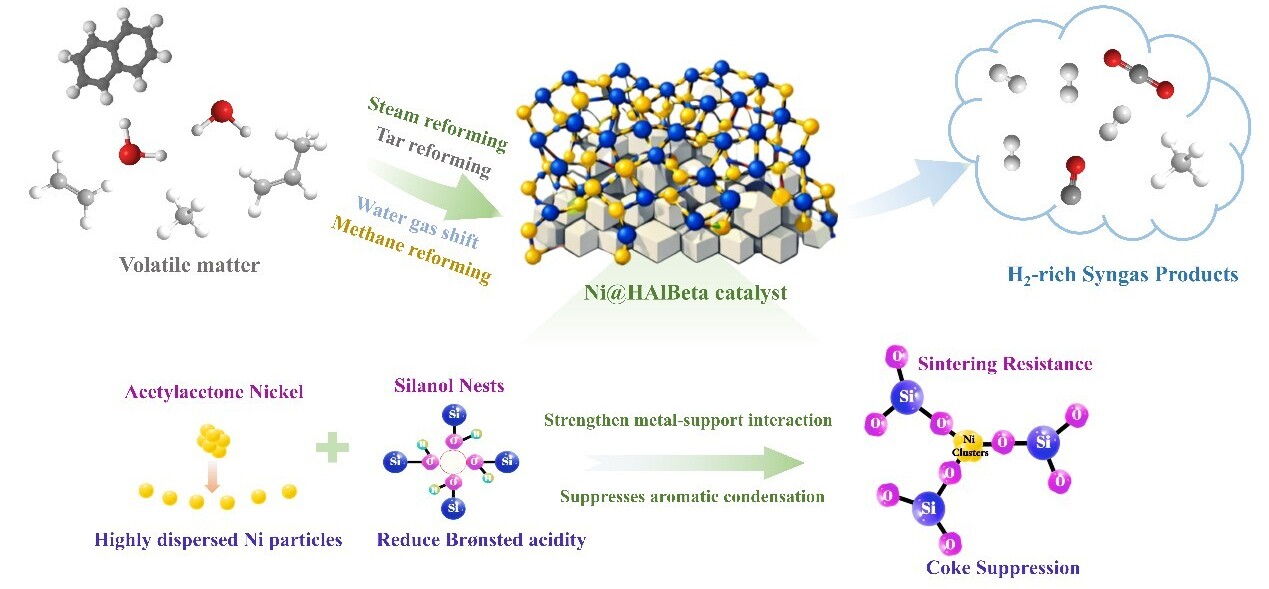
Figure 1 Schematic route for high performance and stability of Ni@HAlBeta catalyst.
附件下载:
 86-991-3835823
 lhszhb@ms.xjb.ac.cn
 86-991-3838957
 40-1 Beijing Nan Road, Urumqi, Xinjiang, 830011, China


Copyright @ Xinjiang Techinical Institute of Physics and Chemistry, Chinese Academy of Sciences. All Rights Reserved
