Novel Strategy: Preparing High-Performance Carbon Anodes from Biomass via Deep Eutectic Solvents
Editor: | Apr 26,2026
Potassium-ion batteries are considered a promising option for large-scale energy storage because potassium is abundant and low-cost. However, their development is still limited by the large size of potassium ions, which makes it difficult for conventional anode materials to store them quickly and stably. Biomass-derived carbon is an attractive alternative, but in most cases its structure is still tuned largely by trial and error. In this study, researchers used cotton stalk as a biomass precursor and deep eutectic solvents (DES) as a controllable reaction medium to address this challenge.
Research group from the Xinjiang Technical Institute of Physics and Chemistry (XTIPC) introduced different metal ions into the solvent system and compared the effects of calcium, magnesium, and zinc. They found that calcium played a unique role during carbon formation. It helped guide the decomposition of the biomass and promoted the formation of a carbon structure with more suitable pores, richer nitrogen active sites, and wider layer spacing. These structural advantages made it easier for potassium ions to move through the material and be stored more efficiently.This work was published in Small Methods.
Under optimized conditions, the calcium-regulated carbon anode, denoted as CCS-DESCa, exhibited the best electrochemical performance among all the samples studied. It delivered a reversible capacity of 320 mAh g-1 at 0.05 A g-1 and maintained 212 mAh g-1 at 1 A g-1. The anode also showed excellent long-term stability, retaining 89% of its capacity after 2000 cycles. Further kinetic analysis indicated a higher pseudocapacitive contribution and faster potassium ions diffusion, suggesting that the calcium ions-induced multiscale carbon structure is beneficial for achieving both high capacity and rapid potassium storage.
The study further revealed how different metal ions in DES affect biomass carbonization and the formation of the final carbon structure. By establishing a clear relationship among metal-ion identity, carbonization behavior, structural characteristics, and potassium-storage performance, the researchers provided a new basis for the rational design of biomass-derived carbon anodes through DES chemistry. The strategy was also found to be applicable to other lignocellulosic precursors, such as pear wood and bamboo powder, demonstrating its promising versatility and scalability.
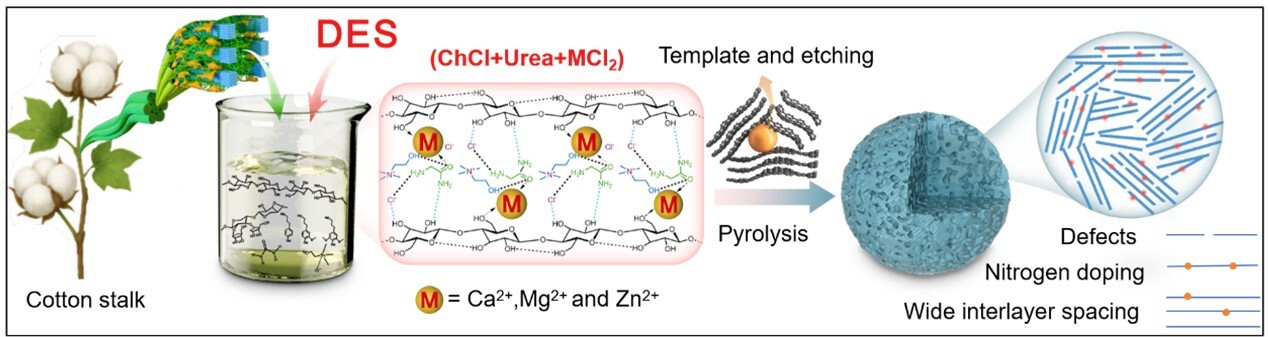
Figure 1. Schematic illustration of how different metal ions in deep eutectic solvents regulate the structural evolution of cotton stalk-derived carbon materials
附件下载:
 86-991-3835823
 lhszhb@ms.xjb.ac.cn
 86-991-3838957
 40-1 Beijing Nan Road, Urumqi, Xinjiang, 830011, China


Copyright @ Xinjiang Techinical Institute of Physics and Chemistry, Chinese Academy of Sciences. All Rights Reserved
