The Power of Pnictogen Bond: As–As Linkages Drive Wide Bandgap, Strong NLO Response and Large Birefringence in SrGa3Si4As11
Editor: | Apr 26,2026
Infrared (IR) nonlinear optical (NLO) crystals serve as core components for achieving frequency conversion in all-solid-state lasers. Currently, the commercial market is dominated by chalcopyrite-like crystals developed abroad in the 1980s, such as AgGaS2 (AGS), AgGaSe2 (AGSe), and ZnGeP2 (ZGP). However, with the rapid advancement of laser technology, these materials' intrinsic performance limitations have made them increasingly inadequate for modern applications. Consequently, there is an urgent need to break through these constraints and develop new IR NLO crystals with superior overall performance to meet the demands of high-efficiency, high-power laser systems. Within the extensive pnictide system, arsenides represent an advantageous platform for designing long-wavelength IR NLO materials due to their exceedingly strong second-order NLO responses and high thermal conductivity. Nevertheless, synthesizing these compounds is challenging, making them extremely rare compared with chalcogenides and phosphides. More severely, the inherently narrow bandgaps of arsenides (typically < 1.0 eV) lead to severe absorption of pump light, which has long hindered their practical applications. Therefore, breaking through the bandgap limitations of arsenides to design new materials with excellent overall performance remains a major hurdle in this field.
The Research Center for Crystal Materials at the Xinjiang Technical Institute of Physics and Chemistry, Chinese Academy of Sciences (CAS), has long been dedicated to the development of new NLO crystals. Recently, the research team led by Prof. Pan Shilie and Prof. Li Junjie achieved a key breakthrough: by introducing As–As homoatomic bonds with large polarizability anisotropy to eliminate the non-bonding electron pairs on As atoms, they successfully designed and synthesized the first experimentally verified quaternary arsenide NLO material, SrGa3Si4As11, within the AII–BIII–CIV–As system. The compound crystallizes in the P63 space group and uniquely features a 3D framework composed of [SrAs9] polyhedra, [GaAs4] and [SiAs4] tetrahedra, along with unique As–As bonds. The introduction of As–As bonds achieves the effect of "one stone, multiple birds", simultaneously enhancing the NLO response, bandgap, and birefringence. This endows the compound with excellent overall performance: a strong phase-matching second-harmonic generation response (~1.6 × ZGP, corresponding to ~8.0 × AGS), a wide arsenide bandgap (~1.59 eV), a high LIDT (~1.5 × ZGP), and a large birefringence (0.10@2090 nm). These results not only enrich the structural diversity of arsenides but also establish As-rich arsenides incorporating homoatomic bonds as an emerging promising platform for developing high-performance long-wavelength IR NLO materials.
The research was published in the prestigious journal Angewandte Chemie International Edition under the title The Power of Pnictogen Bond: As–As Linkages Drive Wide Bandgap, Strong NLO Response and Large Birefringence in SrGa3Si4As11. PhD candidate Hongshan Wang is the first author, and Prof. Junjie Li and Prof. Shilie Pan serve as the corresponding authors.
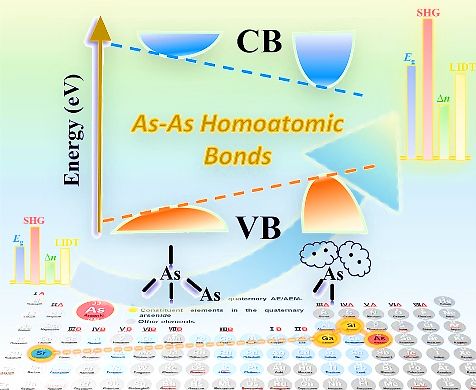
Figure 1. By introducing As–As homoatomic bonds, a balance between bandgap, NLO response, and birefringence was achieved, leading to the design and synthesis of the high-performance quaternary arsenide mid-/far- IR NLO material SrGa3Si4As11.
附件下载:
 86-991-3835823
 lhszhb@ms.xjb.ac.cn
 86-991-3838957
 40-1 Beijing Nan Road, Urumqi, Xinjiang, 830011, China


Copyright @ Xinjiang Techinical Institute of Physics and Chemistry, Chinese Academy of Sciences. All Rights Reserved
