Progress in UV Birefringent Crystals
Editor: | Jun 08,2026
With the rapid advancement of optical technology in recent years, the demand for high-performance birefringent crystals has been growing steadily. Significantly enhancing birefringence remains a major challenge in the field of optical crystals. The Crystal Materials Research Center at the Xinjiang Institute of Physics and Chemistry, Chinese Academy of Sciences, has proposed a “redox-driven” strategy. By precisely controlling the coordination environment of tin-based compounds, the group has successfully synthesized layered organic-inorganic hybrid crystals with high birefringence. This research provides new design insights for the development of high-performance optical materials.
This study successfully designed and synthesized two tin-based compounds with distinct coordination geometries—(C5N2H7)SnCl3 and (C5N2H7)2SnCl6—by regulating the valence state of tin ions through redox reactions. Among these, the compound (C5N2H7)2SnCl6 exhibited significant optical properties, with a birefringence of 0.45. This is attributed to the application of a redox-driven strategy, which enables tin ions to switch between the Sn2+ and Sn4+ valence states, thereby inducing a transition from the tricoordinated [SnCl3]- to the hexacoordinated [SnCl6]2- octahedral configuration. The [SnCl₆]2- octahedra regulate and optimize the parallel alignment of π-conjugated planar groups, forming a layered structure that significantly enhances the compound’s birefringence. This study establishes a new paradigm for regulating metal coordination environments via redox processes and provides an effective strategy for developing high-performance birefringent crystals.
The research findings were published in the Advanced Functional Materials with the title “Redox-Driven Strategy Enabling Leapfrog Enhancement of Birefringence in Layered Tin-Based Optical Crystals”. The Xinjiang Institute of Physics and Chemistry is the only corresponding institution. Researchers Pan Shilie and Hou Xueling from the Center for Crystal Materials Research are the corresponding authors. Doctoral candidate Jia Hangwei is the first author. This research was supported by grants from the National Natural Science Foundation of China, the Strategic Priority Research Program of the Chinese Academy of Sciences, and the Major Science and Technology Program of the Xinjiang Uygur Autonomous Region.
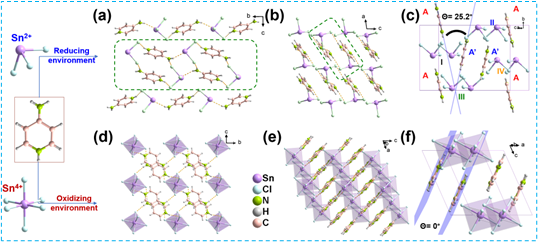
Figure: The crystal structures of (C5N2H7)SnCl3 and (C5N2H7)2SnCl6
附件下载:
 86-991-3835823
 lhszhb@ms.xjb.ac.cn
 86-991-3838957
 40-1 Beijing Nan Road, Urumqi, Xinjiang, 830011, China


Copyright @ Xinjiang Techinical Institute of Physics and Chemistry, Chinese Academy of Sciences. All Rights Reserved
