Research Pogress in Exact Charge Transfer Control in Quantum Dots/Molecule System–induced Large Emission Contrast for Ultrasensitive and Anti-interfering Detection
Editor: | Jun 08,2026
formance sensing platforms owing to their size-tunable emission wavelengths, broad excitation spectra, narrow emission bands, high quantum yields, and exceptional photostability. Nevertheless, conventional QDs-based ratiometric fluorescence sensors predominantly operate via a “responsive + reference” single-signal mode, which inherently restricts their dynamic range.Accordingly, precise modulation of interfacial charge interactions between QDs and organic molecules enables synchronous yet opposite dual-signal responses (i.e., an ideal ratiometric sensing mode). This mechanism not only amplifies the detection contrast and SNR for target analytes but also offers a versatile strategy for fabricating high-performance fluorescence sensing platforms.
To address this challenge, a research team led by Prof. DOU Xincun from the Xinjiang Technical Institute of Physics and Chemistry of the Chinese Academy of Sciences (CAS) has proposed a hydrogen-bond-driven self-assembly strategy to construct a QDs/molecule sensing system, denoted as CdSe/ZnS QDs@FNAC. Their findings, published in Nano Research,demonstrated that precise interfacial assembly and charge transfer regulation enable a dual-signal ratiometric fluorescence response with high SNR.
Specifically, carboxyl-terminated CdSe/ZnS QDs@MPA was prepared via a ligand exchange strategy, and a naphthol-based molecular probe (FNAC) featuring a twistable acrylate moiety was designed and synthesized. The self-assembled system was then established through hydrogen bonding between the aldehyde groups of FNAC and the surface carboxyl groups of the QDs. Owing to the twisted intramolecular charge transfer (TICT) within the molecular probe and the photoinduced electron transfer (PET) between the probe and the QDs, the system exhibited exclusively red fluorescence from the QDs at 639 nm under 365 nm UV excitation. To verify the ratiometric dual-emission fluorescence response of this self-assembled system, potassium permanganate (KMnO4), a typical oxidant that poses hazards to environmental protection and human health, was selected as the research analyte to systematically investigate the detection performance of CdSe/ZnS QDs@FNAC toward the target analyte. The results reveal that upon exposure of the self-assembled system to KMnO4, the PET between the QDs and molecular probes is suppressed, while the concurrent oxidative etching of the QDs quenches their red fluorescence emission at 639 nm. Concurrently, the acrylate moieties in FNAC undergo oxidative cleavage and subsequent hydrolysis, blocking the TICT pathway to generate green-fluorescent products emitting at 521 nm. Therefore, this self-assembled system achieves a synchronous, inversely correlated dual-signal ratiometric response characterized by the quenching of red emission and the activation of green fluorescence. Compared with conventional single-signal sensing modes, the proposed strategy remarkably amplifies variations in the fluorescence intensity ratio, thereby significantly enhancing both detection sensitivity and the SNR. Further investigations demonstrate that the CdSe/ZnS QDs@FNAC system exhibits outstanding sensing performance toward KMnO4, featuring a rapid response time (<1 s) and an ultralow detection limit (4.80 nM). Moreover, the developed sensor possesses excellent selectivity and anti-interference capability against various potential interferents, including common oxidants, reductants, anions, and cations.
This work was supported by theNational Natural Science Foundation of China, Key Research Project of Chinese Academy of Sciences,Natural Science Foundation of Xinjiang, Central Government Guidance Fund for Local Sci-Tech Development, Tianshan Talents Plan, Tianshan Innovation Team Plan, Youth Innovation Promotion Association of the Chinese Academy of Sciences.
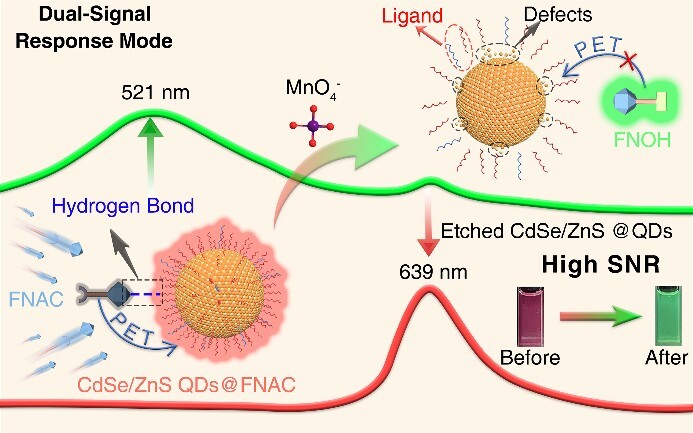
Figure: Schematic illustration of the hydrogen bond-driven non-covalent self-assembled CdSe/ZnS QDs@FNAC system design strategy. (Image by the research team)
附件下载:
 86-991-3835823
 lhszhb@ms.xjb.ac.cn
 86-991-3838957
 40-1 Beijing Nan Road, Urumqi, Xinjiang, 830011, China


Copyright @ Xinjiang Techinical Institute of Physics and Chemistry, Chinese Academy of Sciences. All Rights Reserved
