Research Progress in Stepwise Conformational Restriction of Acylhydrazone-Based Molecules for High Signal-to-Noise Fluorescent Recognition of Synthetic Cannabinoid FUB-INACA
Editor: | May 30,2026
To address this challenge, a research team led by Prof. DOU Xincun from the Xinjiang Technical Institute of Physics and Chemistry of the Chinese Academy of Sciences (CAS) has proposed a novel design strategy for acylhydrazone-based sensing materials. By varying the number of aldehyde substituents on triphenylamine derivatives, the team achieved the progressive evolution of material dimensionality and gradual conformational restriction. Their findings, published in Angewandte Chemie International Edition, demonstrate that tuning these substituents effectively restricts conformational freedom and suppresses intrinsic background fluorescence, thereby significantly improving both detection sensitivity and the SNR.
In this study, based on the excited-state intramolecular proton transfer (ESIPT) mechanism, researchers designed and synthesized a series of acylhydrazone-based sensing materials with diverse dimensionalities, utilizing 1H-imidazole-4,5-dicarbohydrazide (IDA) and triphenylamine (TPA) derivatives as the fundamental building blocks. It was demonstrated that as the number of aldehyde substituents on the triphenylamine unit increases from 1 to 3, the materials assemble into zero-dimensional (0D) discrete molecules (DPA-IDA), one-dimensional (1D) linear polymers (DFTA-IDA), and two-dimensional (2D) covalent organic frameworks (TFPA-IDA COF), respectively. To explore the inherent relationship between stepwise conformational restriction and the enhancement of the SNR, FUB-INACA, a new psychoactive substance widely abused worldwide, was selected as the representative detection target. We systematically investigated the effects of conformational freedom on the intrinsic luminescence behavior and target sensing performance. The results reveal that as the dimensionality gradually increases from 0D to 2D, the geometric architecture evolves from a linear conformation to a highly twisted state. This transition drastically enhances conformational restriction, suppressing the ESIPT process and resulting in a 50% decrease in intrinsic fluorescence intensity. Remarkably, upon interaction with the synthetic cannabinoid FUB-INACA, the three architectures exhibit fluorescence quenching, fluorescence enhancement, and fluorescence turn-on responses, respectively.Further investigations reveal that the response mechanism transitions from photoinduced electron transfer (PET)-induced fluorescence quenching in the 0D system to a profound fluorescenceenhancement in the 2D system. This enhancement is synergistically driven by the inhibition of ESIPT and the activation of intramolecular charge transfer (ICT). Notably, benefiting from its near-zero background emission, the 2D TFPA-IDA COF demonstrates exceptional fluorescence sensing capabilities toward the synthetic cannabinoid FUB-INACA, with a remarkable fluorescence enhancement factor of 5421.95% (54.22-fold), an ultralow detection limit of 1.3 nM, and an ultrafast response time of < 1 s. Building upon these exceptional sensing capabilities, a three-layer microfluidic sensing chip was fabricated by integrating 3D printing and screen-printing technologies. This device enables the anti-interference, visual screening of the synthetic cannabinoid FUB-INACA in complex matrices. Overall, this work provides a valuable paradigm for the rational design of zero-background fluorescent sensing materials, paving the way for the highly sensitive, high SNR detection of hazardous chemicals.
This work was supported by National Key Research and Development Program of China, National Natural Science Foundation of China, Key Research Project of Chinese Academy of Sciences, Natural Science Foundation of Xinjiang, Tianshan Talents Plan, Youth Innovation Promotion Association of the Chinese Academy of Sciences, and Key Research and Development Program of Xinjiang.
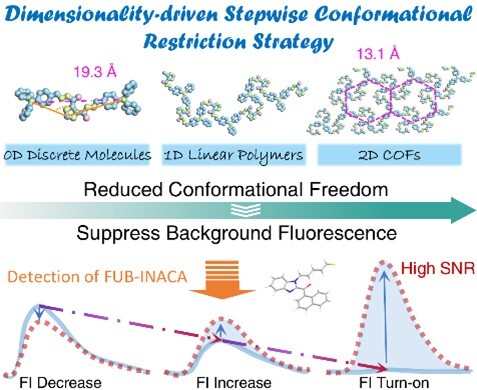
Figure: Schematic illustration of the stepwise conformational restriction strategy. (Image by the research team)
附件下载:
 86-991-3835823
 lhszhb@ms.xjb.ac.cn
 86-991-3838957
 40-1 Beijing Nan Road, Urumqi, Xinjiang, 830011, China


Copyright @ Xinjiang Techinical Institute of Physics and Chemistry, Chinese Academy of Sciences. All Rights Reserved
