Researchers Develop Ultrafast Dual-Mode Sensor for Cathinone Derivatives
Editor: | Jun 09,2026
Synthetic cathinones, a major class of new psychoactive substances, have become an increasing challenge for public health and law enforcement because of their high toxicity, addictive potential, rapidly changing structures, and frequent concealment in complex samples. Conventional laboratory methods can provide accurate identification, but they often require sophisticated instruments, trained operators, and relatively long analysis times. Researchers from the Xinjiang Technical Institute of Physics and Chemistry, Chinese Academy of Sciences, have now developed a rapid, specific, and easy-to-read sensing strategy for cathinone derivatives.
The study, recently published in Analytical Chemistry, reports a π-conjugation-tuned fluorescent and colorimetric probe based on the excited-state intramolecular proton transfer (ESIPT) mechanism. The team designed three carbazole-imidazole probes with progressively extended π-conjugation and identified IM-3 as the optimal molecule. By strengthening cooperative noncovalent interactions, including π-π stacking with the aromatic ring of methcathinone and N-H···N hydrogen bonding with its amine group, IM-3 can recognize methcathinone, a representative cathinone derivative, with high specificity.
Upon binding to methcathinone, the probe undergoes a photoinduced electron transfer process that suppresses ESIPT emission. This produces two clear signals: green fluorescence is rapidly quenched under 395 nm ultraviolet light, and the probe solution changes from yellow to colorless under natural light. Such dual-mode output provides cross-validation between instrumental fluorescence readout and naked-eye color inspection, improving reliability and reducing the possibility of false judgment in practical analysis.
The optimized system showed an ultrafast response, with a visible colorimetric change within 0.8 s and a fluorescence response within 2 s. It achieved detection limits of 4.7 μM in fluorescence mode and 6.6 μM in colorimetric mode. Importantly, the probe maintained good selectivity against 19 potential interferents, including classical drugs, other new psychoactive substances, and structurally related analogues, and performed robustly across varied pH and temperature conditions.
To move the method toward field application, the researchers further integrated IM-3 into a portable solid-liquid separation sensing device. The probe-functionalized substrate enabled dual-mode detection of methcathinone in simulated real-world samples, including wastewater, blood, chocolate, and beverages, as well as in an authentic specimen. Recovery experiments and blinded tests confirmed reliable performance in complex matrices.
Supported by the Postdoctoral Fellowship Program of China Postdoctoral Science Foundation, Natural Science Foundation of Xinjiang, Key Research and Development Program of Xinjiang and Tianchi Talent Plan, this work establishes a general molecular design strategy for detecting low-nucleophilicity inert analytes. Beyond cathinone screening, the approach may inspire next-generation probes for rapid public security monitoring, forensic analysis, and on-site detection of new psychoactive substances.
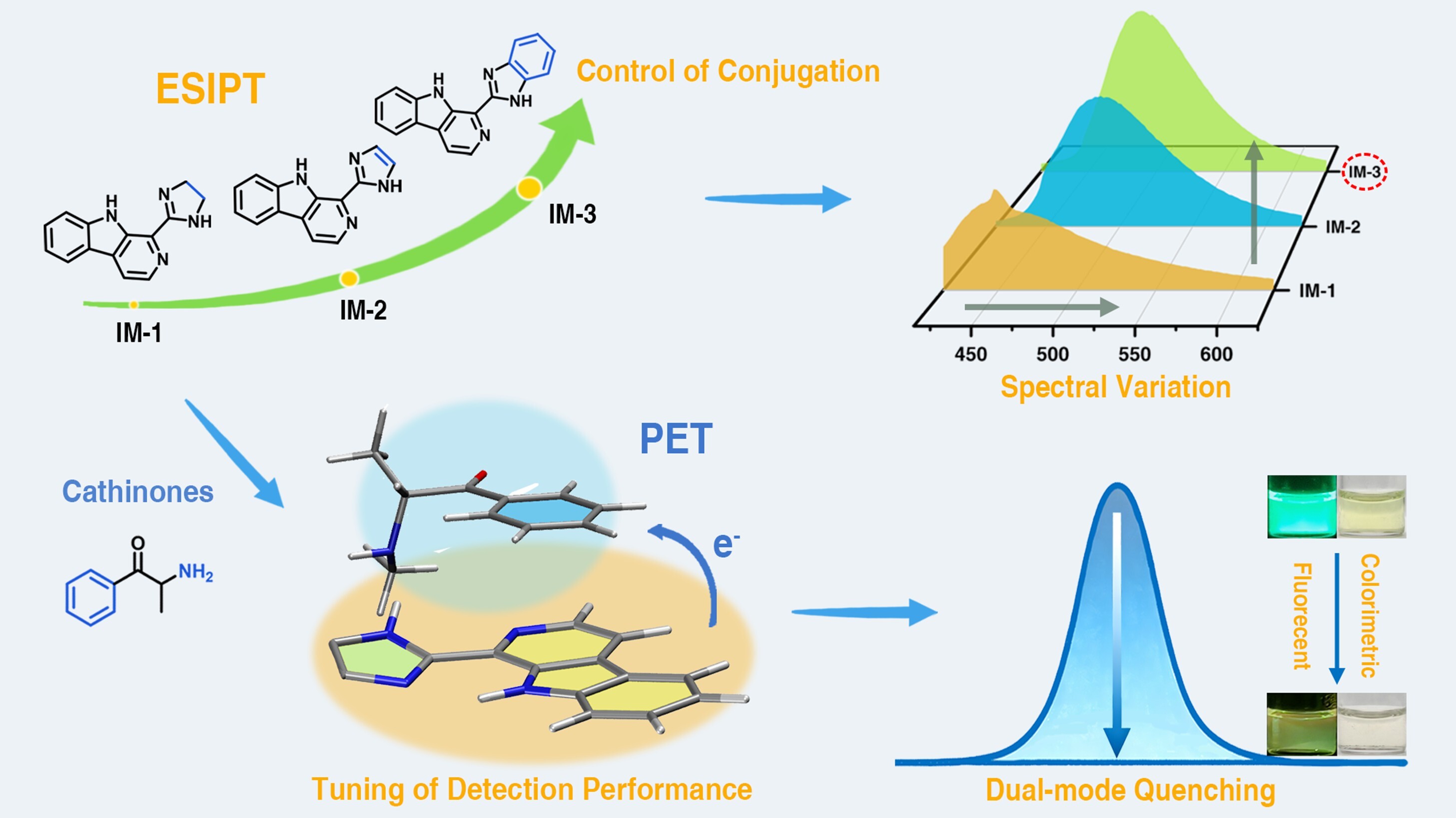
Figure:Design strategy of π-conjugation-regulated probes for dual-mode cathinone detection (Image by the XTIPC)
附件下载:
 86-991-3835823
 lhszhb@ms.xjb.ac.cn
 86-991-3838957
 40-1 Beijing Nan Road, Urumqi, Xinjiang, 830011, China


Copyright @ Xinjiang Techinical Institute of Physics and Chemistry, Chinese Academy of Sciences. All Rights Reserved
