Progress in Structural Evolution Mechanisms of Antiferroelectric Materials
Editor: | Jun 24,2026
Antiferroelectric materials, owing to their electric-field-induced reversible antiferroelectric–ferroelectric phase transition, hold significant application prospects in pulsed power systems, electric vehicles, displacement sensors, shape memory devices, and related fields. The dipole configurations of classical antiferroelectric systems, represented by PbZrO3, have been extensively studied. However, in structurally more complex Pb(B′1/2B′′1/2)O3-type perovskite oxides, the competing interaction mechanisms arising from the ordered arrangement of B-site complex cations remain unclear, hindering the rational design of high-performance complex antiferroelectric systems.
To address this scientific challenge, a research team from the Xinjiang Technical Institute of Physics and Chemistry, Chinese Academy of Sciences (CAS), in collaboration with the Shanghai Institute of Ceramics (CAS), Fujian Institute of Research on the Structure of Matter (CAS), City University of Hong Kong, and Central South University, systematically investigated Pb(Lu1/2Nb1/2)O3 (PLN)-based antiferroelectric materials, revealing their atomic-scale structural evolution and polarization reorientation mechanisms. The related findings were published in Advanced Functional Materials under the title "Structural Evolution of Lead Lutetium Niobate-based Antiferroelectric Materials" Dr. Xiaoming Yang from the Xinjiang Technical Institute of Physics and Chemistry and Dr. Bing Han from the Shanghai Institute of Ceramics are the co-first authors, while Professors Xifa Long and Shilie Pan from the Xinjiang Technical Institute of Physics and Chemistry, and Professor Shujun Zhang from City University of Hong Kong are the co-corresponding authors.
To directly observe the atomic-scale polarization behavior, the team employed aberration-corrected high-angle annular dark-field scanning transmission electron microscopy (HAADF-STEM). Imaging along the [001]p direction revealed that PLN, PLN-2PT, and PLN-5PT all exhibit clear eightfold-periodic antiparallel Pb displacements. However, in PLN-5PT, local regions showed period deviations, consistent with the diffuse scattering observed in selected-area electron diffraction (SAED). More critically, statistical polar plot analysis of Pb displacement vectors revealed an important evolutionary trend: with increasing Ti content, the direction of Pb displacement gradually rotates from ~45°/-135° in pure PLN to ~30°/-120°, enabling continuous tuning of the in-plane polarization direction.
First-principles calculations indicate that Ti doping induces a rotation of polarization from in-plane to out-of-plane and reduces the antiferroelectric–ferroelectric phase transition energy barrier. This three-dimensional polarization pre-alignment effect significantly lowers the rotational energy barrier required for the electric-field-driven transition from the antiferroelectric state to the ferroelectric <111>ₚ state, explaining at the atomic structural level the experimentally observed reduction in critical field and enhanced ferroelectricity. This mechanism is fundamentally distinct from the in-plane collinear "↑↑↓↓" model in classical PbZrO3, providing a new design paradigm for the functional optimization of complex antiferroelectric systems.
This work was supported by the CAS Strategic Priority Research Program, the National Natural Science Foundation of China, the CAS Youth Innovation Promotion Association, and the CAS Scientific Research Equipment Development Project.
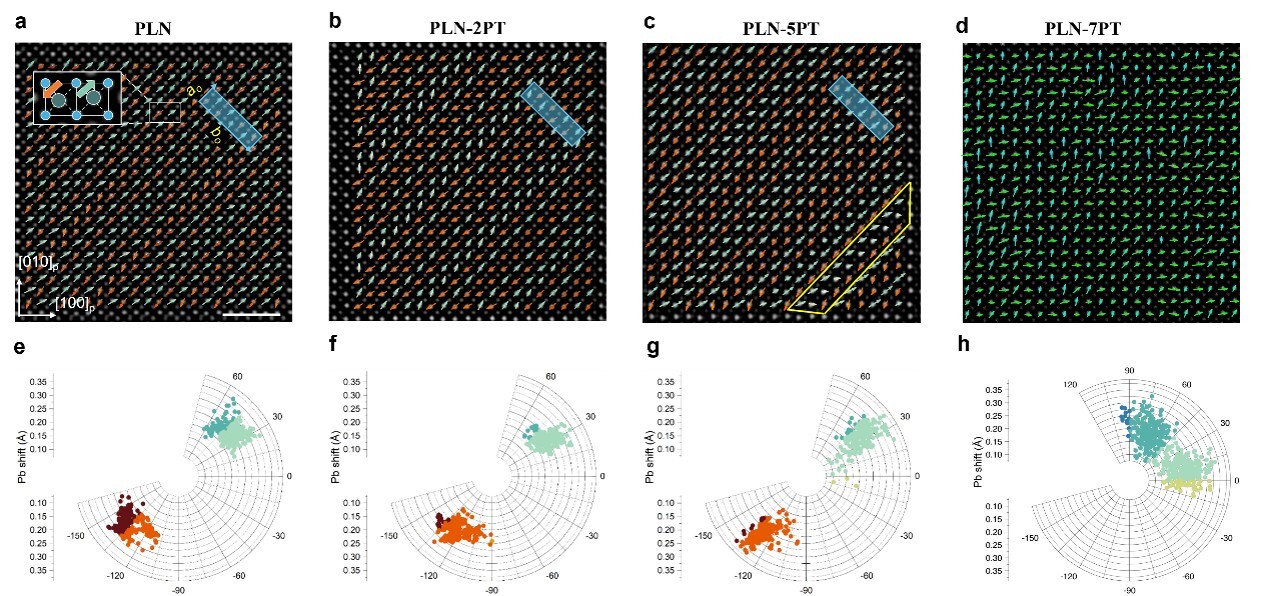
Figure 1. Atomic structure and Pb displacement mapping at (001)p plane of PLN with varying Ti content.
附件下载:
 86-991-3835823
 lhszhb@ms.xjb.ac.cn
 86-991-3838957
 40-1 Beijing Nan Road, Urumqi, Xinjiang, 830011, China


Copyright @ Xinjiang Techinical Institute of Physics and Chemistry, Chinese Academy of Sciences. All Rights Reserved
