Unlocking Bright COFs: Quantum Confinement by Molecular Design
Editor: | Sep 04,2026
Covalent organic frameworks (COFs) hold great promise for optoelectronics and sensing, yet COFs with high photoluminescence (PL) and general design rules remain scarce. Since the quantum confinement effect achieved through physical downsizing dramatically enhances PL (as in graphene quantum dots), can we apply this concept to COFs? A recent Viewpoint from Prof. DOU Xincun et al. at the Xinjiang Key Laboratory of Trace Chemical Substances Sensing, Xinjiang Technical Institute of Physics and Chemistry, Chinese Academy of Sciences, now offers a compelling answer: by strategically isolating the conjugation units, one can confine excitons at the molecular level and dramatically boost PL efficiency. This Viewpoint was published in Accounts of Materials Research.
The group’s prior experimental study (Cell Reports Physical Science 2025, 6, 102721) had already revealed that a cyclohexane-linked COF delivered a solid-state PL quantum yield of 73%—outperforming other imine-COFs and even the parent tetraphenylethylene monomer. To understand this exceptional behavior, the authors turned to the well-known mechanism of graphene quantum dots, where size reduction below the exciton Bohr radius increases binding energy and discretizes energy bands. Drawing a parallel, they argued that the in-plane conjugated backbone of 2D COFs can similarly modulate excitonic states, but in most cases, the delocalized π-electrons allow exciton migration, leading to unwanted annihilation and PL quenching.
This argument is supported by the group’s exciton dynamics studies, which confirm that interrupting the conjugation in COFs enables quantum confinement, suppresses exciton diffusion and annihilation, and consequently enhances PL efficiency.
Moreover, the Viewpoint also outlines several pressing challenges that must be overcome to establish the generality of this quantum confinement strategy and push COFs toward practical applications in luminescent devices and chemical sensing.
This work was supported by the National Key Research and Development Program of China and National Natural Science Foundation of China.
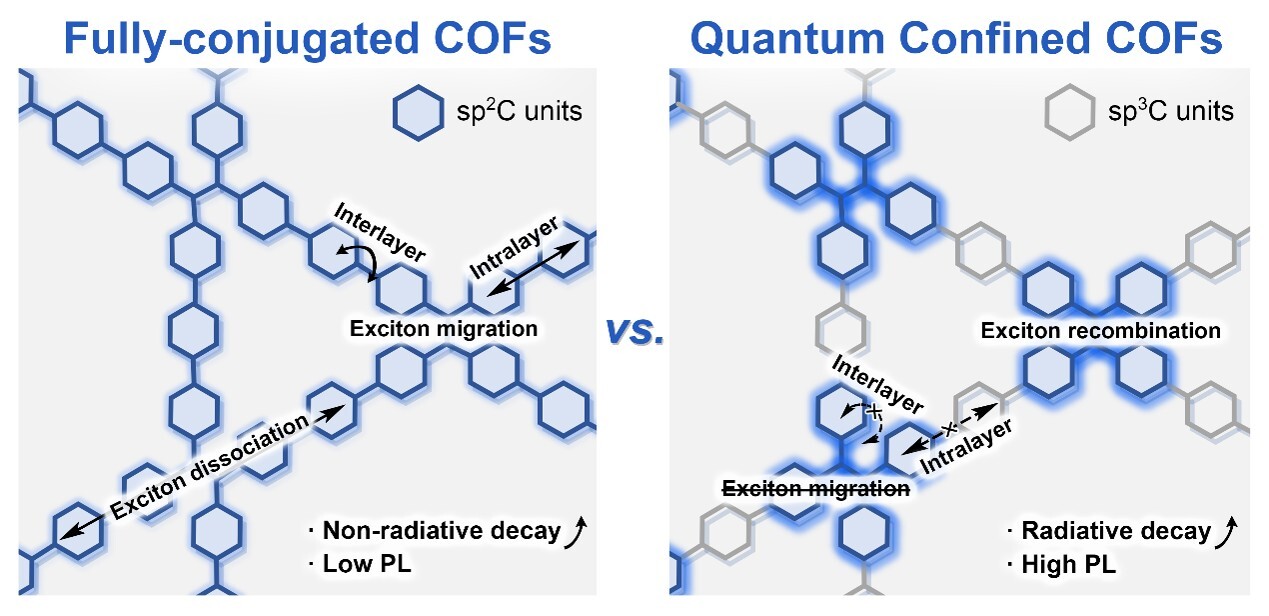
Figure: Schematic representation of conjugation-break-induced quantum confinement. (Image by the research team)
附件下载:
 86-991-3835823
 lhszhb@ms.xjb.ac.cn
 86-991-3838957
 40-1 Beijing Nan Road, Urumqi, Xinjiang, 830011, China


Copyright @ Xinjiang Techinical Institute of Physics and Chemistry, Chinese Academy of Sciences. All Rights Reserved
