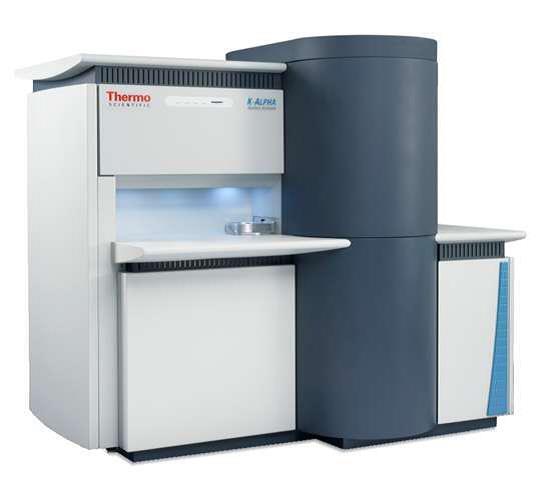
X-ray Photoelectron Spectrometer(K-Alpha+)
Editor: | Jul 22,2026
Instrument Name: X-ray Photoelectron Spectrometer
Model: K-Alpha+
Manufacturer: Thermo Fisher Scientific (USA)
Overview:
X-ray photoelectron spectroscopy (XPS) is a mainstream technique for surface characterization. It identifies elemental compositions and reveals chemical states on material surfaces. XPS data supports qualitative analysis, chemical-state differentiation, and elucidation of molecular bonding configurations. This robust technique serves diverse fields, including solid-state physics, chemistry, biology, geosciences, mineralogy, materials science, semiconductors, ceramics, and polymers. Typical applications include surface composition/valence analysis, depth profiling, elemental mapping, surface electronic structure studies, and ultra-thin film thickness/component evaluation. The probing depth is approximately 0–10 nm.
Key Specifications:
Analyzer: 180° double-focusing hemispherical analyzer with a 128-channel detector
X-ray Source: Monochromatic Al Kα micro-focused source; tunable spot size from 30 to 400 μm (5 μm steps); minimum spot ≤ 30 μm; max power: 72 W (at 400 μm spot); energy resolution: 0.5 eV
Ion Gun: Energy range: 100 – 4000 eV
Charge Neutralization: Dual-beam ultra-low energy electron flood gun; resolution: 0.82 eV; sensitivity: ≥ 2000 kcps at 1.0 eV resolution
Sample Stage: Four-axis manipulator; sample area: 60 × 60 mm; max thickness: 20 mm
Vacuum System: Two 220 L/s turbo-molecular pumps (load-lock and analysis chambers) – automatic startup; 3-filament titanium sublimation pump (TSP)
Data System: Avantage software suite – process-licensed – computer included
Additional Notes:
1. Detects all elements except H and He. Elements below 1 at.% may not yield measurable signals.
2. Suitable for solid samples only. For bulk materials, please confirm the maximum allowable height before testing.
3. Supports Auger spectroscopy, valence-band analysis, and sputter depth profiling (typically up to ~5 nm).
4. Samples containing Fe, Co, Mn, or Ni are considered magnetic and require special handling. Samples with S, F, or other volatile species should be discussed with staff prior to analysis.
5. Porous or high-specific-surface-area bulk samples should be cut to millimeter dimensions to minimize outgassing time.
6. Clean and dry samples thoroughly before measurement. For heat-resistant samples, thermal desorption at the maximum allowable temperature is recommended. Skip cleaning/desorption if surface contamination is to be preserved. Avoid bare-hand contact and prolonged air exposure. Store samples in clean vials, tubes, or bags to prevent contamination.
 86-991-3835823
 lhszhb@ms.xjb.ac.cn
 86-991-3838957
 40-1 Beijing Nan Road, Urumqi, Xinjiang, 830011, China


Copyright @ Xinjiang Techinical Institute of Physics and Chemistry, Chinese Academy of Sciences. All Rights Reserved
