Distinct Activity‑Stability Behaviors of Fe‑N₄ and Fe‑N₄O₂ Single‑Atom Sites in Fenton‑Like Catalysis
Editor: | Nov 09,2026
Iron‑based single‑atom catalysts (Fe‑SACs) hold great promise for heterogeneous Fenton‑like water remediation, yet their practical deployment is severely hampered by the intrinsic activity‑stability trade‑off. Under harsh acidic oxidative environments, isolated Fe atoms tend to leach from carbon supports and trigger rapid deactivation. Rational modulation of local coordination environments to reconcile high catalytic activity and structural robustness remains a critical challenge for designing advanced single‑atom Fenton catalysts.
Prof. Yang Liping and Prof. Yin Jiao’s research team at the Research Center for Energy and Chemical Engineering, Xinjiang Technical Institute of Physics and Chemistry (XTIPC), Chinese Academy of Sciences carried out comparative structure‑performance investigations between Fe‑N₄ and Fe‑N₄O₂ single‑atom moieties. Taking mesoporous MCM‑41 as a confined support and o‑phenylenediamine as ligand, polymerizable monomer and nitrogen source, the group fabricated a core‑shell confined Fe‑N₄ single‑atom catalyst denoted SiO₂@Fe‑N‑C via an in‑situ polymerization‑pyrolysis route. Comprehensive characterizations including XRD, HAADF‑STEM, XPS and synchrotron‑based X‑ray absorption spectroscopy (XAS) validate atomic dispersion of Fe species within nitrogen‑doped carbon shells, well‑defined symmetric Fe‑N₄ coordination configuration, and well‑preserved ordered mesoporous framework originating from MCM‑41.
The as‑synthesized SiO₂@Fe‑N‑C delivers outstanding Fenton‑like catalytic performance. Under mildly‑acidic conditions, nearly complete removal of 2,4‑dichlorophenol (2,4‑DCP) is achieved within 20 min with an apparent rate constant of 0.70 min⁻¹ and a mineralization efficiency of 62%. The catalyst maintains over 95% pollutant‑removal efficiency across ten successive cycling tests with negligible iron leaching. EPR and radical‑quenching experiments verify that ·OH serves as the dominant reactive oxygen species assisted by ¹O₂. The degradation proceeds through sequential dechlorination, hydroxylation and ring‑opening pathways towards final mineralization. Combined DFT calculations and post‑reaction XPS measurements uncover a “strong adsorption‑low perturbation” mechanism. Compared with asymmetric Fe‑N₄O₂ sites, symmetric Fe‑N₄ centers enable favorable reactant adsorption originating from enhanced orbital hybridization, while only ~0.01 e⁻ charge transfer occurs during catalysis to retain structural integrity of active sites. This feature successfully decouples the conventional activity‑stability trade‑off in Fenton‑like catalysis. This work establishes explicit correlation between coordination symmetry and catalytic performance, offering fundamental design principles for developing highly‑efficient and durable Fe‑based single‑atom Fenton‑like catalysts.
This study was completed by interdisciplinary teams from XTIPC. The corresponding paper entitled Activity‑Stability Differences in Fenton Catalysis: Distinct Roles of Fe‑N₄ and Fe‑N₄O₂ Sites has been published in the Journal of Catalysis. Wang Xiaoyan is the first author, and Prof. Yang Liping together with Prof. Yin Jiao act as co‑corresponding authors. This research was financially supported by the Key Research and Development Program of Xinjiang Uygur Autonomous Region, the Xinjiang Tianshan Talent Training Program, and the Youth Innovation Promotion Association of the Chinese Academy of Sciences.
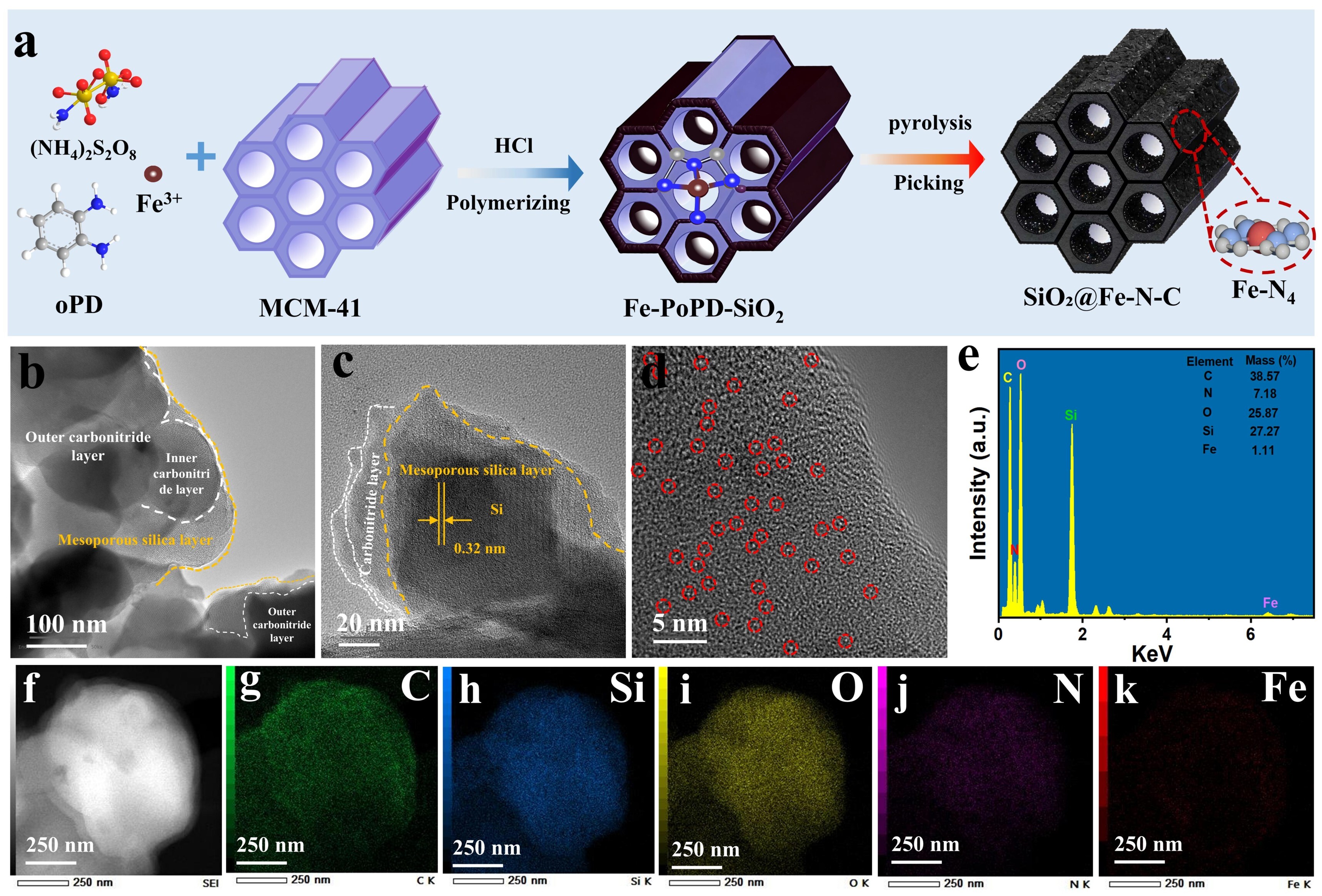 Figure 1: Fabrication of core‑shell confined SiO₂@Fe‑N‑C catalyst and Fe‑N₄‑driven Fenton‑like degradation of 2,4‑DCP toward high activity and long‑term cycling stability. (image by Prof. YIN Jiao’s group)
附件下载:
 86-991-3835823
 lhszhb@ms.xjb.ac.cn
 86-991-3838957
 40-1 Beijing Nan Road, Urumqi, Xinjiang, 830011, China


Copyright @ Xinjiang Techinical Institute of Physics and Chemistry, Chinese Academy of Sciences. All Rights Reserved
