Densification Propagated Closed-Pores in Hard Carbon for High Energy Density Sodium-Ion Batteries
Editor: | Nov 09,2026
Hard carbon (HC) is regarded as an ideal anode material for sodium-ion batteries (SIBs) due to its wide availability of precursors and tunable structure. Its abundant closed-pore structure delivers excellent plateau sodium-storage capacity in the low-potential region (< 0.1 V vs. Na/Na⁺), which is key to enhancing the energy density of SIBs. Biomass-derived hard carbon has attracted considerable attention owing to its renewable resources, low cost, and competitive reversible capacity. However, the intrinsically complex and heterogeneous structure of biomass makes it difficult for traditional methods to precisely regulate its microcrystalline structure and closed-pore characteristics. Therefore, exploring a green, efficient, and universal strategy for tuning the closed-pore structure of biomass-derived hard carbon is of great significance for promoting the large-scale application of high-energy-density SIBs.
Prof. Yin Jiao’s lab at Research Center for Energy and Chemical Engineering, Xinjiang Technical Institute of Physics and Chemistry (XTIPC), Chinese Academy of Sciences developed a physical densification-carbonization strategy to prepare a series of hard carbons with abundant closed-pore structures. Lignin was subjected to densification treatment under different pressures. XRD and FTIR analyses showed that the micro-crystallinity and orientation of lignin were significantly enhanced after densification. In-situ EPR and in-situ TG-FTIR-MS analyses further revealed that during carbonization, the in-situ intensified hydrogen bonds accelerated the dehydration process, accompanied by the generation of carbon-centered radicals, thereby promoting the formation of closed pores and enhancing the plateau capacity of lignin-based hard carbon.
Benefiting from the construction of the above closed-pore structures, the optimized hard carbon as an anode material for SIBs exhibited significantly improved electrochemical performance: the reversible capacity increased from 304.7 to 386.4 mAh g⁻¹, and the plateau capacity increased from 154.4 to 226.4 mAh g⁻¹. When paired with a Na₃V₂(PO₄)₂F₃@C cathode, the full cell delivered a high energy density of 297.7 Wh kg⁻¹. In addition, the effectiveness and universality of this strategy were verified using cellulose and wood powder as precursors. This work elucidates the role of the hydrogen-bond-intensified crystallization mechanism in closed-pore construction and develops a green and efficient approach to enhance the plateau capacity of hard carbon anodes, offering broad prospects for high-energy-density SIBs.
This study has been published in the Chemical Engineering Journal entitled with Densification propagated closed-pores in hard carbon for high energy density sodium-ion batteries was financially supported by the National Key R&D Research Program of China, the National Natural Science Foundation of China, the Tianshan Talent Plan of Xinjiang and the Youth Innovation Promotion Association of the Chinese Academy of Sciences.
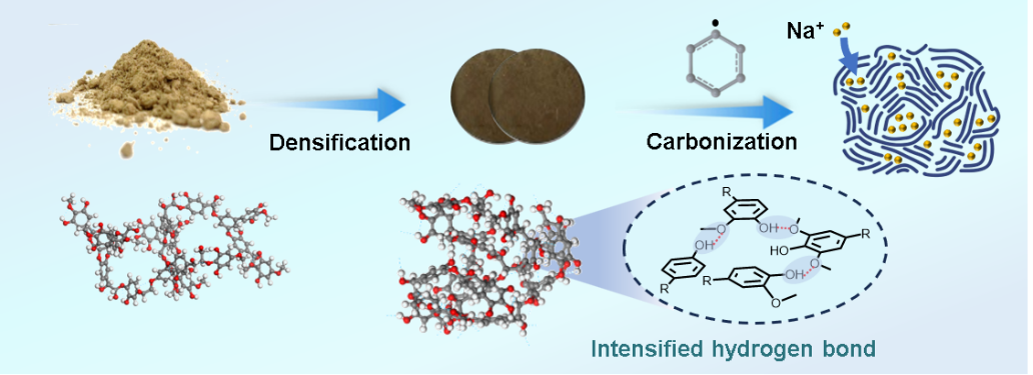
Figure 1. Densification treatment constructs closed-pore structures in lignin-derived hard carbon for efficient sodium-ion storage. (image by Prof. YIN Jiao’s group)
附件下载:
 86-991-3835823
 lhszhb@ms.xjb.ac.cn
 86-991-3838957
 40-1 Beijing Nan Road, Urumqi, Xinjiang, 830011, China


Copyright @ Xinjiang Techinical Institute of Physics and Chemistry, Chinese Academy of Sciences. All Rights Reserved
